Holy Week 2013 Thoughts

This year as Easter approaches, I feel somewhat caught off-guard.  I no longer work in church ministry (for now), and it was strange during Christmas this year I wasn’t planning Easter dramas and music…

I have participated in a very self-revealing Lent this year that has exposed parts of my heart.  I  gave up all television and movie watching (apart from watching things with friends, and an occasional Sunday I watched a few shows).  Six weeks is a long time.  But in many ways it has gone by really quickly.  I’m still not quite ready for Easter.

There is much to be said about this significant week, you can read some of my posts from Holy Week 2012 for more devotional reads.  I was a little more dedicated last year.

As I slaved away this week writing a paper on the sacrificial system in Leviticus, there was a phrase that caught my attention: the wrath of God satisfied.  Of course this reminds me of In Christ Alone (what phrases DON’T remind me of a song?), but in this case it was in the context of Leviticus 16, The Day of Atonement.  Once a year, the High Priest made an offering for the corporate sins of the Israelite people.  This was to show: the constant daily sacrifices made by the people for their sins was not enough.  For a Holy God to continue to dwell among his people and for his wrath to not consume them, atonement had to be made.

God.  Dwelling in the camp with His people.

I still am blown away by this.

Anyway.  I started this post earlier this week, and now it’s Good Friday.  I’m saving more on Leviticus 16 for another post, but for now, for today, we rejoice in the brutal, humiliating death of our Lord Jesus Christ.  A sacrifice perfect and sufficient.  Unlike the Hebrew people needing to continually make sacrifices in Leviticus, this sacrifice satisfied the wrath of God.

Completely satisfied.

thedaythattruelovediedcrossmotion1

I Breathe You In

The presence of the living God,
Satisfies the depths of my heart
All of me changed when you came,
Iʼm made free by Your glory and grace

I breathe You in God, cause You are thick all around me 
I breathe You in God, cause You are thick all around me

The brightness of Your loves pure light,
Pierces through the darkest of nights
Everything is possible now,
For God is here and God is good

You are good God, 
For You are good to me You are Good God, 
For You are good to me

When I donʼt understand Iʼll choose You
When I donʼt understand I will choose You God
When I donʼt understand I will choose to Love You God


Texas Toast!

ImageFriends,

I’m (finally) able to happily announce: I’m moving to Dallas, Texas!  After much time of prayer, and a top secret visit to Dallas in April, it became clear that it was time to move, and time to begin graduate studies at the well-respected Dallas Theological Seminary.

I’m not even sure what to say, it has absolutely been the hand of God making all the details come together, and though the personal and monetary sacrifices are great, I know that he holds each moment in his hands.

To some, it may seem drastic that I would begin grad school, but actually I’ve been (slowly) working on my Master’s degree, while working full time, in bits and pieces over the past three years through Liberty University Online.  (I’m still anxiously awaiting to hear if any of my classes have transferred, but that’s hopefully beside the point.)  God placed a small seed in my heart while I was teaching in Thailand, nearly 4 years ago, that it was something I desired to pursue, and now that dream is happening.

I will be studying Media and Communications, and unlike what some think, I’m not making some huge career change.  I hope to continue doing what I do now, only in a greater capacity, with a more comprehensive understanding of the scriptures and Theology, and of course study more in depth what I do now– Audio/visual presentation, drama, worship, creative writing, and more of the “creative” side of worship ministry.  My heart for music and leading worship has never changed, I’m so grateful for the invaluable time I have spent working at FBC over the past 3 years, and I could never say thank you enough for believing in me, and giving me the experience I treasure greatly.  The difficult days/weeks/etc. only have grown me to be stronger in my walk with the Lord, and have made me more the person I am today.  I suppose this is true and can be said of any life experiences we have.

There is so much more I could say, I know this may come as a shock to some people, and at the same time other people have been shocked that I actually have stayed here for the 3 years I’ve worked at FBC.  It’s all apart of God’s wonderful plan, and I simply want to humbly walk forward in faith.

If you think of me, please pray for me also.  It has been 5 years since I graduated with my undergraduate degree, so it may be a bit of a shock being in school again!  There are also so many small details that need to come together- from where I will be living, to selling all my belongings, to finding a job when I arrive in Dallas.

Thanks everyone- much love.
Meridith

Worship and Hymns: Worship of Hymns?

Some of the oldest hymns we sing today are maybe 200 years old.  It has been nearly 2,000 years since Christ walked this earth.  The rich “heritage” and “tradition” many hold near and dear to their hearts when it comes to music, probably isn’t really “traditional” at all…

I feel like I could blast out a blog going so many different directions right now…

[HYMNS] an introduction.

Music has always been a staple in the Christian faith, over both the Old and New Testament, we see many examples of songs that were written; songs written in battle, defeat, victory, quiet moments, joyous events, and spontaneous songs of praise as well.  I’d like to speak about the text of hymns first, and then talk about musicianship, and writing hymns secondly.  I will try my best to refrain from making personal comments and observations until the conclusion. 

Generally, in the function of music in the church, the text is perceived as the most important piece of worship, and rightfully so.  But, let us not forget the importance of musicianship, and playing skillfully, as the Psalmist speaks about.  And as recorded in 1 Chronicles 15:22, “Chenaniah, leader of the Levites in music, was to direct the music, for he understood it” (emphasis mine).  The importance of knowing music is vital, because music is a powerful emotional tool to bring humanity to Christ.  There is also another topic I would like to touch on, and that is the tension between the old and the new.  Christianity has always held tightly (sometimes too tightly) to the traditions passed down by our forefathers, however, the Psalmist speaks about singing a “new song” to the Lord (Psalm 96:1, Psalm 33:3…), and the prophet Isaiah also speaks about God doing a new thing, and to forget the former ways (Isaiah 42-43).  Living in the tension of tradition, and the new and what is to come is part of the dichotomy of knowing Christ, and walking with him, and if you will (musical pun intended), the dissonance of harmonies being played all at once, making it into something beautiful.

Forgive my scattered thoughts, but this is turning into bit more of an academic research paper, than just a blog post.

Over countless years, the Christian Church has seen many, many beautiful hymns [songs] written, speaking of the character and life of Christ, articulating theology in a very real and artistic way, and speaking about the life of the Christian.  There are many wonderful hymns/songs out there, but there are also many terrible hymns as well.  Don’t get me started on this…. We digress.  Anyway, the purpose of music in worship is an agent for connecting the human, to the divine.  This spans across religions.  There is something absolutely beyond this world that is the very essence of what music is.  The human and Divine meeting together as one and creating something beautiful, but also more mysterious than we could ever understand with our minds as humans. 

[HYMNS] text.

First, the text of a hymn can be approached in many different ways, but one common “formula”, if you will, that many hymn writers use is a progression of earth to heaven, in various different ways.  Just a few examples of this are: Amazing Grace, Abide with Me, It is Well With My Soul, How Great Thou Art (this is in fact actually a modern day hymn), among many, many others. 

For this particular examination of music, there will not be as much focus on how hymn text was written, but I do want to highlight that when the Liturgy was established and standardized by Charlemagne (more on him in the coming section), it also set a standardized text for Mass sung in churches.  In these days, circa 500 AD, the text remained the same each Sunday, and as time progressed, different composers would simply set this same text to different music and arrangement. 

This was the structure of the Mass, the liturgy sung and spoken by the people:

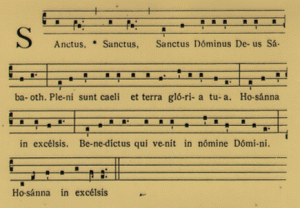
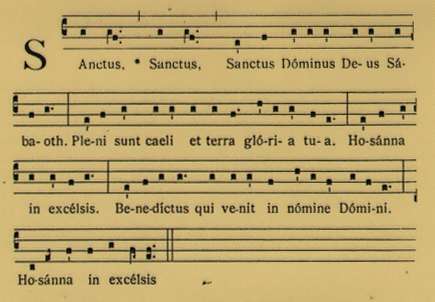
The same overtones of the Mass are still a large part of what happens from week to week (in some form or fashion) in our Evangelical churches even today.  Kyrie was the only Greek element to the Roman mass, and the words “Lord have mercy, Christ have mercy“, was the translations of what was sung.  Gloria, the story of Christ’s birth, and the songs the angels sang to announce Christ’s birth.  Sanctus, meaning Holy, resonating in parallel with Isaiah 6, Agnus Dei, worthy is the Lamb who was slain, and so forth.  (Some of this I’m spouting from memory, other pieces from this book.  Read more on good old wikipedia).  As you can see, many of the songs we sing in our churches today are singing these exact same words, in different and new ways.  Not much has changed over time, and our traditions are still traditions, but in a new way.

[HYMNS] early church history. music.

Next, I will attempt to highlight in broad terms about the musical side of how hymns were written, and are written.  In the early days of the church, the church was the only source for well written and well performed music.  The church set the tempo for what expectations were when it came to music, and all this music, was worship.  In the Medieval Era, circa 400 AD, there was a significant draw away from secular music all together.  Monasticism communities were a way people could withdraw from the societal pressures of living in the world, and Christians could live distinct lives devoted completely to serving God, which also had a huge impact on music in the church.  This music was “Gregorian chant”, or also called “plainchant”, and vocal music was generally all monophonic (sung in the same tone and one melody), and slightly polyphonic also (different melodies sung together at the same time). 

Other historic events also lead to more development in music within the church, including the rule Charlemagne, where Christianity was made the official religion in the Roman Empire, and he also standardized many forms of worship, and lead to great musical development.  From his rule, he standardized a unified liturgy, along with music, as discussed earlier.

Another vital piece of the history of church music is to also understand that in these days, within the first 800-1,300 years of Church History, music was performance based, there was no participation required of the listener, only to simply listen and be moved by the music.  Music was left up to the professional, trained musician (this was not the case in the Old and New Testament, only what we see in this particular era).

As musical styles unfolded in the 1,000-1,700 AD range, so did the development of more secular music, and a departure from music only being performed within the church; but several factors influenced what emerged out of church music from this time frame.  First being the birth and events of Martin Luther’s life, the father of the Reformation.  Luther, as many may not realize, was a theologian, but also a hymn writer as well.  Part of his view on the separation from the Catholic Church was that worship should be something that was participatory, as he composed many congregational hymns.  His “preposterous” view that the mass be changed from Latin, to German was an outrageous suggestion, but at the time most people would attend church and not hear a word of the actual language they spoke.  Congregational songs, where the attender in church could engage in, was a huge breakthrough, and even now, as this is the basis for what church music and worship is today. 

Luther said, quoting Augustine, “For music is a gift…of God, not a gift of men [sic]… Therefore accustom yourself to see in music your Creator and to praise him through it”.  Luther also was a proponent for secular music being an avenue for worshipping God, and his famous hymn “A Mighty Fortress is Our God”, used the same tune as a secular song, and was used as a congregational hymn. 

Much more could be said of the road Martin Luther paved, but that is an entirely different blog/book. 

I’d like to also mention and briefly highlight Johann Sebastian Bach, as most everyone, secular or Christian, would agree made huge strides in both the vocal and classical music genres, and was a composer, choirmaster, and Church musician his entire life.  Almost all the songs he ever composed were songs of worship, for the glory of God.  It is quite interesting to consider, since his legacy is regarded as one of the most influential musicians and composers who ever lived.

[HYMNS] then and now.
(this is the part all of you who skipped the long history might want to read)

Tradition is what makes humans, human.  We cannot deny this fact.  Tradition makes our churches what they are today, however, if we as Christians now, in the twenty-first century are simply relying on our own “evangelical” or “gospel” traditions, we are missing the boat.  It’s already sailed, long ago.  Let’s admit it: music is something that touches our hearts, so if we are truly honest, we want to hear sometimes the music and songs that were meaningful to us as we went through a difficult time, or songs that were significant to bringing us to Christ, but let us not confuse this with being “better” or more spiritual.  This is called personal preference.

Let us educate ourselves.  If people at Church ABC are continually requesting “hymns”, but what they really want are the Gospel songs written in the 50’s by the Gather’s, then let us just say it like we mean it: we want what makes us feel good.  We cannot be Christians that continually live in the past and the “good old days”, because, as mentioned in the introduction, God is continually working , and he is doing new things even today (Isaiah 42-43).  The church is called to engage in a conversation with the culture we live in, but the purpose of the church is not to be “hip” and “cool”.  The church is called to acknowledge tradition (and by “tradition” I mean TRUE tradition– such as the early church as seen in Acts), not just the “tradition” that we were raised on, whenever we happened to be born.  God has put us on this earth, now, “for such a time as this”, and we can choose to acknowledge this, or simply live on our own planet, and not engage with what is going on.

My main point is this: our expression of our faith can never be divorced from our culture.  Don’t believe me?  Research the New Testament, in particular, and you will see that the language used, phrasing and wording, things Paul addresses in his letters, etc., were all things that had to do with the culture of THAT day.  So we, as students of the scriptures, can do our very best to examine this, and prayerfully seek the Spirit to know how those truths translate to us today. 

Don’t read me wrong, we are not going to be singing Justin Bieber in church, or sacrifice the truths that are TRUTHS, but we cannot continue to live in the dark.  We cannot simply request all our favorite songs from the 50’s because that’s the ONLY way we can connect with God, God is beyond time.  God is beyond musical style.  Wrap your brain around that!

As I mentioned in the introduction, we are called to simply connect the human with the Divine, through music and worship.  This can be done by singing scripture, theological truths, telling the story of Christ, and speaking to our own humanity.  We can communicate this through painting a musical picture, simply through an instrumental piece.  But let us not miss the simple fact of this: it is all for the glory of God.  It is not for us. 

Do you hear what I’m saying?  It is not about US.  It is not about the songs WE want.  It is not about how the songs make US feel. 

It is all about HIM. 

God’s majesty.  His beauty.  His reign in our hearts and lives. 

May we never miss this, because if we do, then we are simply attending church to worship ourselves.

—–

Sources cited:
“A History of Music in Western Culture”
“Jubilate 2: Church Music in Worship and Renewal”

Nica 2012

Time flies and it’s hard to believe it has been a year since I was last in Managua, Nicaragua.  There are many emotions as I have prepared, but in the midst of a very, very busy and stressful time here at work, there will be a little air to breathe as I get to chaperone a group of High School students on a mission trip to Nicaragua.  I have the most amazing job.

God always is up to something, and every time I’ve gone, He has surprised me with his strength (which I shouldn’t be!), peace, hope and joy in the faces of these children.

Pray for us.  We fly out March 21st, and return the 30th.  Check up on us through the week with our blog.

travel reflections: India

When I traveled and lived in India for 2 months after I graduated from college in 2007, there were many things about my experience there that will forever alter the way I view life.  I remember the long plane rides, and long lay overs in the various airports that threw a blanket of tiredness over our team, but did not extinguish my joy for being there, though the trip would be overshadowed by a darkness I never could quite put my finger on.

Car ride from Medford to Redding
Van trip from Redding to San Fransisco
Midnight flight from San Fransisco to Taipei
Flight from Taipei to Bangkok
Flight from Bangkok to Kolkata, India
Overnight sleeping in the Kolkata airport
Flight from Kolkata, India to Dimapur, India.

I believe it could have been a full 48 hours before we finally reached our place of arrival: Great Comission Kid’s Academy in outside of Dimapur, India, in Nagaland.  The only Christian state in India, and you’ve probably never heard of it.

Though we were all more tired than we ever had been in our lives, or probably ever will be, we were warmly greeted at the school by the most precious children I have ever met.  Each one was truly beautiful, and their smiles lighted up their faces.  I quickly became acquainted with my friends Abane, Jenny, and Zuve, and they showed us girls to our room.

It was hot, that was for sure.  The heat invades you from deep down, and it feels like you are constantly sweating, or have just gotten out of the shower.  We put our suitcases carefully alongside the wall, and organized ourselves. We would be there for 5 weeks, but at that point, we all just wanted to close our eyes and nap.  However, there was no rest for us, we were immediately introduced to all the children, and to the Dozo family, who run the school.  The kids were precious, and had prepared an entire program for us!  We felt welcomed, even though we were quite weary from our travels.

The Naga people are not Indian in their culture and practices.  There are many tribes of the Naga people, and they are decedents of southern China, as far as nationality is, and they look Asian and not Indian.  There was a long history of the Naga people being headhunters; they killed foreigners, and especially Christians for many, many years.  In the 1970’s the was a huge revival that swept through Nagaland, and many, many were saved, and they stopped headhunting.  The history is incredible, but the result of this revival was a culture becoming Christian.

Anyway, rambling.  My heart was touched by these children.  They had a heart for Jesus to know him and serve him, most wanted to be missionaries when they grew up!

The most difficult thing about India was not this first part of the trip.  Nagaland was like a home away from home, a family across the ocean, and I still correspond with them even today.  My heart broke time and time again, and became hard again and again while walking the streets of Kolkata.

We took an overnight bus to Shillong, a beautiful part of India, it was stunning.  Then, we flew from Guwahati to Kolkata.

As soon as walking outside the Kolkata airport, it is complete chaos, and you are hit by a million smells, and a wave of heat even greater than Nagaland.  Loud and noisy taxi drivers trying to rip off foreigners, and then potentially even kill you en route to your destination; driving as fast and as dangerously as possible.  Upon our arrival at the airport, we were supposed to be met by our other team, already in Kolkata, but after waiting several hours, we figured they were not coming.  We needed to find our way to either the guest house they were staying at, or just find some place to stay, as it was getting late.

I was angry at this point, our team was comprised of people who did not like to take charge, including our team leader, so naturally being the activator I am, I took charge.  “Let’s just find some place to stay, and we will find them in the morning.  It’s getting late, and it’s too dangerous for us to just be wandering the streets”.

Daniel and I (the more assertive of the group) told the team to wait with all our luggage, and we set out to find a guest house that was generally clean, and that had “air con” (which was the most important thing we were looking for in the pollution and humidity of downtown Kolkata).  We were so hungry, we hadn’t eaten since breakfast and it was well past 9 or 10 at night at that point.  I didn’t care anymore, I was just ready to find a place and go to sleep before I began to say anything I would regret to our team members.

As Daniel and I walked the streets we found many foreigners in this section.  I was shocked at how many of them were just sitting out on the streets, conversing with locals in Hindi, and many of them enjoying a cold beer.  I was fascinated; they looked as though they had made this place their home, at least for now, but didn’t they have families?  What were they doing all the way across the world?  As many of them appeared to be Americans, or Europeans.  I was so intrigued.

After stopping at quite a few guest houses, we finally found one at a decent price, “600 rupees a night, with air con”, the large Indian man said in broken English.  I looked at Daniel, “I don’t think we will find anything better, and these look pretty clean.”  He agreed, “Yes, it will have to do for tonight, I will find an internet cafe and let Cassie know where we are, hopefully they will find us in the morning”.  Daniel had been looking forward to seeing his girlfriend Cassie for quite some time, he and I had enjoyed some good conversation the past 5 weeks on the team, but he was certainly ready to see Cassie after so much time apart.  I smiled, “I’m not worried, we will find them in the morning”. It also was Daniels’ 21st birthday that day, oh, I knew he wanted to see Cassie, but for the night, I had arranged for one of our friends in Nagaland to buy him a little special 21-year-old beverage (shh don’t tell!).  At least he would have that tonight, I knew I wouldn’t be able to steal away and enjoy a sip with him, our leader was a little uptight about those things.

We returned to the rest of the team, and showed them our place.  When asked if I wanted anything to eat, I replied with a self-loathing response, “No, I’m not hungry.  I’m just going to bed”.

As soon as I shut my eyes, I drifted off into a hard sleep, and tried to not think about the hardness of the beds, or the fact that there could be little creatures in our sheets.

We spent three weeks in Kolkata, and to this day I still have many distinct memories from my time there.  It was really, really difficult, one of the most difficult times in my life, only unlike the children on the streets, or the dying man laying on the side of the road with a small cup begging for money, I had a beautiful home to return to, and lots of material belongings.  They had nothing.  The brokenness became hardness in my heart.  Every time I stepped out onto the streets, I had to ignore the children.  Ignore the beggar.  Ignore the stares and whispering.  I had to pretend I could not see or hear them.  India is a corrupt government, so even if we gave to these people, the money would likely go to a harsh owner of these people.  If you have seen the film Slumdog Millionaire, you know some of this.

We eventually found our other team, and stayed in a beautiful guest house with an amazing garden outside, away from the loud, busy streets of Kolkata.  A haven from the harsh world outside.

But to this day, I still see all their faces.  I still wonder if they are alive.  I still wonder: how do we bridge the gap between poverty and wealth?  How can I change the hearts of these people?  Only God can bring an answer to these questions, but we can be faithful to pray.  Pray that God will provide, as he does, and pray that these people can be reached with the hope of the gospel.  That is what matters.  That is what the goal is.

Forgiven Much

There’s a lot more I could have said, and I wanted to say.   Worship flows out of understanding ourselves in relation to who God is, and realizing how he sees us: as forgiven.  And by the way, completely unrelated, Robbie Seay Band released a new CD, you should support them and buy it here, it’s amazing!

Here you go, if you haven’t read the eConnect already, or if you care to read:

Staff Corner
Meridith Johnson
, Worship Director

Forgiven Much

       As we have journeyed through Galatians, it seems the word “legalism” and “legalistic” has been used quite a number of times, but part of understanding our legalistic ways, also comes from understanding the depth of our sin and our depravity.  Part of this process involves naming sin for exactly what it is: brokenness and separation from the heart of God.
       In Luke 7, there is a familiar story of Jesus eating with the Pharisees, and during the meal, a “certain immoral woman” came with an expensive jar of perfume, and began to anoint and wash his feet.  Listen to this account of Luke, verse 38 says, “Then she knelt behind him at his feet, and she wiped them off with her hair.  Then she kept kissing his feet and putting perfume on them.”  The natural response of the Pharisees was something like this, “If he knew who this woman was, and the kinds of sin she has committed, how could he let this woman touch him!?”
      There are many lessons in this particular account of Christ, but what Jesus says at the end of this section is something to be taken to heart, “I tell you, her sins- and they are many- have been forgiven, so she has shown me much love.  But a person who is forgiven little shows only little love.”  One commentary states, “The woman was not forgiven because of her love; rather, she loved because she was forgiven.  Her faith brought her salvation…” (The Bible Knowledge Commentary, 224).
      When it comes to legalism in our hearts, how often do we sit back with arms folded and disapproving looks on our faces when someone begins to admit their sin?  This week, Greg will share with us about good behavior, our motives behind our good behavior and what it really reveals about our hearts.  We have been forgiven of much, so therefore, we should love much.  Our love comes from gratitude in our hearts from the simple act of forgiveness.
       I love this story, from Luke 7, because each of us can find ourselves in one or both of the parties spoken about, the sinful woman, and the arrogant Pharisee.   How can we seek to identify ourselves as sinners, who have been forgiven, and to love much?  What are our motives behind our actions?  Is it true “love” for Christ?  Or simply out of legalistic expectations?

Take a few moments to read through this poetic song, of the story from Luke 7, when our response toward Christ and others is motivated by gratitude and love, our worship becomes authentic, and our love for others is even more genuine.

From glass alabaster she poured out the depths of her soul ,
O foot of Christ would you wait if her harlotries known?
Falls a tear to darken the dirt of humblest offerings to forgive the hurt.
She is strong enough to stand in your love I can hear her say:
I am weak, I am poor, I am broken Lord, but I’m yours […]
Looking forward to worshiping with you all on Sunday,
 Meridith

peering into the past, from the future.

I chuckle, but also I was stunned as I ran across this tonight.  This was a blog I had written in an old notebook, to be posted I guess later that day.  It was written in fall 2005, my Junior year of college, 20 years old, and actually reminds me more of what my realities were then, helps me understand where I used to stand on some things.

When you read, you’ll see why, it’s funny, but totally crazy too.  Comments to come later.


November 13, 2005 11:22 a.m.

Currently, as I’m composing this blog, I’m sitting at Lisa Popeill’s “Workshop for Singing Non-Classical Styles” or something like that).  Al I can say is I’M BORED!  If I could, I would start walking back to Redding right now.

It’s all interesting, I completely agree.  BUT I just don’t want to be here.

So, my mind is wandering, we’ll see what I feel like writing about.  I wish I had a computer in front of me, instead of all these notes.

Anyway, I have been thinking quite a bit about many subjects.  I’m thankful that God reveals things to us in his time.  For quite a while, I always felt that I wouldn’t get married until I was much older, like 25 or 26 (even though it’s not THAT old).  Anyway, but as of late, over this past summer, and this semester, I’ve begun to really pray for the Lord’s will on this subject.

(fast forward some boring things)

One of the reasons I’ve been thinking about this quite a bit has to do with what’s going to happen in my life after I graduate.  For a while, I thought about graduate school, and it’s still in the back of my mind.  but I really believe God is calling me to be a full-time Worship Pastor.

As a woman, I would be very fearful to enter into the ministry and be single.  I mean, yes, I know I COULD do it, but without that support?  I know if I had great friends around me, living with me, that would be AMAZING, but the truth is I don’t know where I’ll be going.

I know I could follow someone whether it’s a significant other or closer friend.  Churches are everywhere, and always could have needs for Worship Pastors.

All I know is what God is calling me to… and I don’t really know what that’s going to look like.  I’m just walking down a road, a path.  I don’t know where I’m heading, but I know I’m following CHRIST with all that’s in me.

death

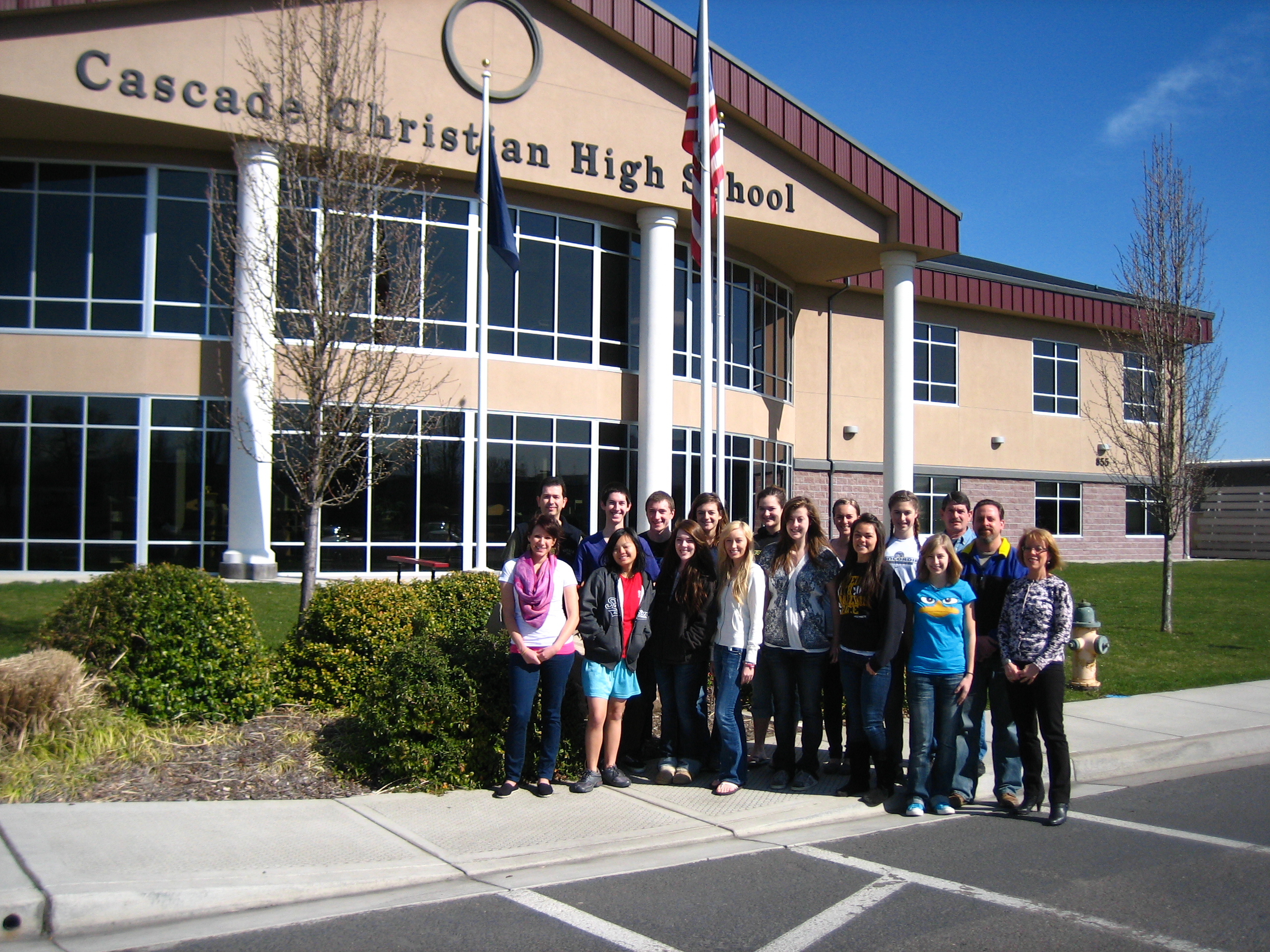
With the past week as America and the world mourned the death of Steve Jobs, it seems death is on everyone’s minds these days, including my own.  Ironically, as I had attended chapel this week at Cascade, the speaker spoke about death also, not even in connection with Steve Jobs at all.

Yet, when I would hear people talking about Jobs, I couldn’t help but feel some kind of, nagging on my heart.  Yes, Jobs was a brilliant man, no one would deny that, and yes, he seems like he was a good man too, but, that’s just it.  He was just a man.  He did change the world, technology-wise, but remember, all this technology will burn one day.  This stuff is just that, stuff.  And in the end does it matter that I do in fact have a Mac Book Pro, or iphone, or ipod or iwhatever…. no.  It doesn’t matter.  Yes, technology makes our lives so much easier, and so much different compared the past, even just 5 years ago, but if I spend all my time engrossed in the technology that I forget to have a conversation (God forbid!) with an actual real person, what does it matter?

If you have some time, I found a great article that really brought to light some of that nagging feeling I couldn’t shake earlier this week, read it here.

Death, for those of us who are believers in God, through the sacrifice of Jesus Christ, we have hope.  We know where we are headed, so it kind of makes everything else secondary, when you really think about it.  I’ve spent some good time thinking about that lately.  How am I spending my money?  How am I spending my time?  How selfish am I being with these things that are “mine”?

It’s all sobering, if we really take the time to think about it.  We could change the world with an ingenious idea, but if we never change a single heart, what does that matter?

What lies ahead

As the dance between summer and fall becomes slower, summer gives way to fall, and a million memories rush.  Memories of what seems like a past life.  Football, high school, happy times, sad times, thankfulness, and everything else I love and hate at the same time.  The rain is a familiar friend, but not always a welcomed friend here in Oregon, but, right now it doesn’t matter much.  It’s just nice to see a little change in the weather for now.

This fall will be different.  I struggle to find the words to say sometimes, but on November 15 I will leave to enter into what often feels like dream land for me, Thailand.  Sometimes I have to pinch myself to remember, oh yeah, that was real, I used to live in Thailand!  I will be grateful to give up a little fall, to return back to summer, and to a time that feels so long ago, yet at the same time seems like just yesterday.  The sights, smells, feeling, I can close my eyes and see it all now.

It is a bittersweet time too.  Remembering what was, not only Thailand, but other memories.  This is a new chapter, so part of this trip will be addressing and understanding that I may not be called back to SE Asia at all, or not anytime soon, or sooner than I expect.  I don’t worry about this, I know what will be, will be.

Either way, it will be an amazing time.

But for now, I will enjoy the cool, crisp mornings, and be super thankful for non-polluted air, and beautiful falls in Oregon.