When we follow the Spirit
and wait for the Lord
We find strength for tomorrow
and trust for His word
I wanna follow You
I wanna go with You, Jesus
When we follow the Spirit
and wait for the Lord
We find strength for tomorrow
and trust for His word
I wanna follow You
I wanna go with You, Jesus
The season of Advent has long been known as the season of waiting. Advent both looks to the past, and the birth of Christ, and to the future, when Christ will once again come back to earth, but come as King. Even before Advent began this year, I sensed a restlessness; a stirring within […]

The season of Advent has long been known as the season of waiting. Advent both looks to the past, and the birth of Christ, and to the future, when Christ will once again come back to earth, but come as King.
Even before Advent began this year, I sensed a restlessness; a stirring within my own heart of both anxiousness and stillness. This season of waiting came as a timely reminder in my own life. Interestingly, I’m apart of a group for a project which we are presenting tomorrow, and the passage we decided to focus on was 2 Peter 3:8-15a:
8 But do not let this one fact escape your notice, beloved, that with the Lord one day is like a thousand years, and a thousand years like one day. 9 The Lord is not slow about His promise, as some count slowness, but is patient toward you, not wishing for any to perish but for all to come to repentance. 10 But the day of the Lord will come like a thief, in which the heavens will pass away with a roar and the elements will be destroyed with intense heat, and the earth and its works will be burned up. 11 Since all these things are to be destroyed in this way, what sort of people ought you to be in holy conduct and godliness, 12 looking for and hastening the coming of the day of God, because of which the heavens will be destroyed by burning, and the elements will melt with intense heat! 13 But according to His promise we are looking for new heavens and a new earth, in which righteousness dwells.14 Therefore, beloved, since you look for these things, be diligent to be found by Him in peace,spotless and blameless, 15 and regard the patience of our Lord as salvation…
There are a number of things about this passage that are notable, especially during the Advent season of looking back and looking forward. As we consider our own lives, where God has moved mightily, and still, areas where it seems God has been silent. A timeless truth to be extracted from this passage is that God keeps his promises. This passage is more concerned with timing, particularly in verse 8 and 9, but the first truth to note is that God will deliver, he will come through. He does not exist within the bounds of time, as we do, he dwells above time itself. Take a moment to ponder that truth: it will blow your mind!
Secondly, “slow”, does not mean he does not hear, and “slow” does not mean no either. This particular passage is speaking about Christ’s return, but I would venture out to say this is a truth that can be applied to any situation. (Or perhaps the greater theological question is: how much intervention does God have in our day to day lives, and how much of our own lives/circumstances do WE have control over… BUT, I will save that for another discussion perhaps.)
When it comes to waiting, I’m a terrible waiter. Waiting at the grocery store, traffic, for the dressing room… it seems like since moving to a big city my wait time and drive time for EVERYTHING has gotten about 10 times longer. I hate waiting. Our culture also hates waiting. Stillness? Quiet? “Wasting time” by not doing anything? These seem like foreign concepts. I constantly am listening to music, checking the weather (77 F and sunny tomorrow), checking the news.. all on this small little portable device I call a “cell phone”… except who even uses the term “cell phone” anymore.. it’s more like phone. Iphone. Something other than “cell phone” or “cellular device”….anyway.
Henri Nouwen is one of my favorite authors, he has a way of penning my thoughts on paper so often. He writes of Advent and waiting:
Just imagine what Mary was actually saying in the words, “I am the handmaid of the Lord. Let what you have said be done to me” Luke 1:38. She was saying “I don’t know what tis all means, but I trust that good things will happen”. She trusted so deeply that her waiting was open to all possibilities. And she did not want to control them. She believed that she when she listened carefully, she could trust what was going to happen.
To wait open-endedly is an enormously radical attitude toward life. It is trusting that something will happen to us that is far beyond our own imaginings. It is giving up control over our future and letting God define our life. It is living with the conviction that God moulds us according to God’s love and not according to our fear. The spiritual life in which we wait, actively present to the moment, expecting new things will happen to us, new things that are far beyond our own imaginination or prediction. That, indeed, is a very radical stance in a world preoccupied with control.

I couldn’t say it any better than the last paragraph. In order to wait, we must give up control, trusting God to work. He is not slow to keep his promises. But we know through His word that His Spirit is with us always, guiding and leading us. And that, in and of itself is a promise fulfilled and alive in us.
So in this season as we celebrate Emmanuel, “God with Us”, Jesus, remember he is still with us, by His Spirit. And still, Christ will comeagain for us. “Then we who are alive and remain will be caught up together with them in the clouds to meet the Lord in the air, and so we shall always be with the Lord.”… 1 Thess. 4:17.
The presence of the living God,
Satisfies the depths of my heart
All of me changed when you came,
Iʼm made free by Your glory and grace
I breathe You in God, cause You are thick all around me
I breathe You in God, cause You are thick all around me
The brightness of Your loves pure light,
Pierces through the darkest of nights
Everything is possible now,
For God is here and God is good
You are good God,
For You are good to me You are Good God,
For You are good to me
When I donʼt understand Iʼll choose You
When I donʼt understand I will choose You God
When I donʼt understand I will choose to Love You God
…just when all was lost.
Hope is what we have in place of that which is not, and in longing for that which is not… yet.
But. Once out eyes behold, and we see, feel, touch, smell… there is no more need for hope. Or faith.
Only love.
Perverted love is all the “love” this world knows
the kind that says now or never
a demanding lust that craves for more and more
This is our world
This is our reality
Sucking the life out of every young man’s eye
stinging every woman deep within her heart
knowing that the “love” she hoped for
doesn’t really seem to exist
this is our world. This is my world. This is 2012.
Does the kind of love exist that we all grew up thinking “love” was?
the kind of love worth sacrifice
the kind of love worth everything
because 1+1 didn’t seem to equal one anymore
in this world at least
the odds just don’t seem to say it can work
“statistics” say it can’t happen
every 1 out of 2 marriages will end
100 percent begin with love
50 percent end with hate
or resentment
or simply shattered hopes
does real love even exist?
does hope for this kind of love even exist?
the love of dying in the arms of the one your heart was made for
the love that is as strong as death
jealousy demanding as the grave
that many waters cannot quench
LOVE
what is love? We ponder.
but the answer is right in front of us
right near to the touch of our fingers
GOD IS LOVE.
who is love?
God.
not lust
not demands
not fear
not skepticism
not ultimatums
not manipulation
not pornography
not lies
not dashed hope
GOD IS LOVE.
some of these things people might find offensive to say
but the reality of our reality
is that love doesn’t seem to exist anymore
and some people. Like me.
ponder if it is possible.
and like you
wonder if it is possible. Real. Does it exist?
or like you, who continue to hope and never seeing
or you who gave your heart again and again only to see it returned in pieces
or you who placed every longing you have in a better world around you.
Real love does exist.
And it already belongs to you.
What if we don’t deserve love?
what we “deserve” is damnation.
we don’t deserve any kind of love
it is a gift. A priceless, precious gift.
Love is sacrifice.
That love is what makes the love our heart longs for.
That love makes us believe again.
But it begins within yourself.
but more importantly, it begins with knowing
you don’t have the ability within yourself.
that comes only from God.
But makes real love, true love.
Does real love exist?
Does the sun rise every morning?
I must believe.
 Friends,
I’m (finally) able to happily announce: I’m moving to Dallas, Texas! After much time of prayer, and a top secret visit to Dallas in April, it became clear that it was time to move, and time to begin graduate studies at the well-respected Dallas Theological Seminary.
I’m not even sure what to say, it has absolutely been the hand of God making all the details come together, and though the personal and monetary sacrifices are great, I know that he holds each moment in his hands.
To some, it may seem drastic that I would begin grad school, but actually I’ve been (slowly) working on my Master’s degree, while working full time, in bits and pieces over the past three years through Liberty University Online. (I’m still anxiously awaiting to hear if any of my classes have transferred, but that’s hopefully beside the point.) God placed a small seed in my heart while I was teaching in Thailand, nearly 4 years ago, that it was something I desired to pursue, and now that dream is happening.
I will be studying Media and Communications, and unlike what some think, I’m not making some huge career change. I hope to continue doing what I do now, only in a greater capacity, with a more comprehensive understanding of the scriptures and Theology, and of course study more in depth what I do now– Audio/visual presentation, drama, worship, creative writing, and more of the “creative” side of worship ministry. My heart for music and leading worship has never changed, I’m so grateful for the invaluable time I have spent working at FBC over the past 3 years, and I could never say thank you enough for believing in me, and giving me the experience I treasure greatly. The difficult days/weeks/etc. only have grown me to be stronger in my walk with the Lord, and have made me more the person I am today. I suppose this is true and can be said of any life experiences we have.
There is so much more I could say, I know this may come as a shock to some people, and at the same time other people have been shocked that I actually have stayed here for the 3 years I’ve worked at FBC. It’s all apart of God’s wonderful plan, and I simply want to humbly walk forward in faith.
If you think of me, please pray for me also. It has been 5 years since I graduated with my undergraduate degree, so it may be a bit of a shock being in school again! There are also so many small details that need to come together- from where I will be living, to selling all my belongings, to finding a job when I arrive in Dallas.
Thanks everyone- much love.
Meridith
Some of the oldest hymns we sing today are maybe 200 years old. It has been nearly 2,000 years since Christ walked this earth. The rich “heritage” and “tradition” many hold near and dear to their hearts when it comes to music, probably isn’t really “traditional” at all…
I feel like I could blast out a blog going so many different directions right now…
[HYMNS] an introduction.
Music has always been a staple in the Christian faith, over both the Old and New Testament, we see many examples of songs that were written; songs written in battle, defeat, victory, quiet moments, joyous events, and spontaneous songs of praise as well. I’d like to speak about the text of hymns first, and then talk about musicianship, and writing hymns secondly. I will try my best to refrain from making personal comments and observations until the conclusion.
Generally, in the function of music in the church, the text is perceived as the most important piece of worship, and rightfully so. But, let us not forget the importance of musicianship, and playing skillfully, as the Psalmist speaks about. And as recorded in 1 Chronicles 15:22, “Chenaniah, leader of the Levites in music, was to direct the music, for he understood it” (emphasis mine). The importance of knowing music is vital, because music is a powerful emotional tool to bring humanity to Christ. There is also another topic I would like to touch on, and that is the tension between the old and the new. Christianity has always held tightly (sometimes too tightly) to the traditions passed down by our forefathers, however, the Psalmist speaks about singing a “new song” to the Lord (Psalm 96:1, Psalm 33:3…), and the prophet Isaiah also speaks about God doing a new thing, and to forget the former ways (Isaiah 42-43). Living in the tension of tradition, and the new and what is to come is part of the dichotomy of knowing Christ, and walking with him, and if you will (musical pun intended), the dissonance of harmonies being played all at once, making it into something beautiful.
Forgive my scattered thoughts, but this is turning into bit more of an academic research paper, than just a blog post.
Over countless years, the Christian Church has seen many, many beautiful hymns [songs] written, speaking of the character and life of Christ, articulating theology in a very real and artistic way, and speaking about the life of the Christian. There are many wonderful hymns/songs out there, but there are also many terrible hymns as well. Don’t get me started on this…. We digress. Anyway, the purpose of music in worship is an agent for connecting the human, to the divine. This spans across religions. There is something absolutely beyond this world that is the very essence of what music is. The human and Divine meeting together as one and creating something beautiful, but also more mysterious than we could ever understand with our minds as humans.
[HYMNS] text.
First, the text of a hymn can be approached in many different ways, but one common “formula”, if you will, that many hymn writers use is a progression of earth to heaven, in various different ways. Just a few examples of this are: Amazing Grace, Abide with Me, It is Well With My Soul, How Great Thou Art (this is in fact actually a modern day hymn), among many, many others.
For this particular examination of music, there will not be as much focus on how hymn text was written, but I do want to highlight that when the Liturgy was established and standardized by Charlemagne (more on him in the coming section), it also set a standardized text for Mass sung in churches. In these days, circa 500 AD, the text remained the same each Sunday, and as time progressed, different composers would simply set this same text to different music and arrangement.
This was the structure of the Mass, the liturgy sung and spoken by the people:

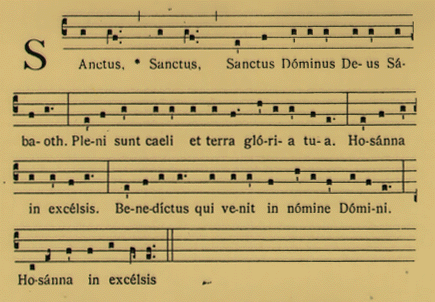 The same overtones of the Mass are still a large part of what happens from week to week (in some form or fashion) in our Evangelical churches even today. Kyrie was the only Greek element to the Roman mass, and the words “Lord have mercy, Christ have mercy“, was the translations of what was sung. Gloria, the story of Christ’s birth, and the songs the angels sang to announce Christ’s birth. Sanctus, meaning Holy, resonating in parallel with Isaiah 6, Agnus Dei, worthy is the Lamb who was slain, and so forth. (Some of this I’m spouting from memory, other pieces from this book. Read more on good old wikipedia). As you can see, many of the songs we sing in our churches today are singing these exact same words, in different and new ways. Not much has changed over time, and our traditions are still traditions, but in a new way.
[HYMNS] early church history. music.
Next, I will attempt to highlight in broad terms about the musical side of how hymns were written, and are written. In the early days of the church, the church was the only source for well written and well performed music. The church set the tempo for what expectations were when it came to music, and all this music, was worship. In the Medieval Era, circa 400 AD, there was a significant draw away from secular music all together. Monasticism communities were a way people could withdraw from the societal pressures of living in the world, and Christians could live distinct lives devoted completely to serving God, which also had a huge impact on music in the church. This music was “Gregorian chant”, or also called “plainchant”, and vocal music was generally all monophonic (sung in the same tone and one melody), and slightly polyphonic also (different melodies sung together at the same time).
Other historic events also lead to more development in music within the church, including the rule Charlemagne, where Christianity was made the official religion in the Roman Empire, and he also standardized many forms of worship, and lead to great musical development. From his rule, he standardized a unified liturgy, along with music, as discussed earlier.
Another vital piece of the history of church music is to also understand that in these days, within the first 800-1,300 years of Church History, music was performance based, there was no participation required of the listener, only to simply listen and be moved by the music. Music was left up to the professional, trained musician (this was not the case in the Old and New Testament, only what we see in this particular era).
As musical styles unfolded in the 1,000-1,700 AD range, so did the development of more secular music, and a departure from music only being performed within the church; but several factors influenced what emerged out of church music from this time frame. First being the birth and events of Martin Luther’s life, the father of the Reformation. Luther, as many may not realize, was a theologian, but also a hymn writer as well. Part of his view on the separation from the Catholic Church was that worship should be something that was participatory, as he composed many congregational hymns. His “preposterous” view that the mass be changed from Latin, to German was an outrageous suggestion, but at the time most people would attend church and not hear a word of the actual language they spoke. Congregational songs, where the attender in church could engage in, was a huge breakthrough, and even now, as this is the basis for what church music and worship is today.
Luther said, quoting Augustine, “For music is a gift…of God, not a gift of men [sic]… Therefore accustom yourself to see in music your Creator and to praise him through it”. Luther also was a proponent for secular music being an avenue for worshipping God, and his famous hymn “A Mighty Fortress is Our God”, used the same tune as a secular song, and was used as a congregational hymn.
Much more could be said of the road Martin Luther paved, but that is an entirely different blog/book.
I’d like to also mention and briefly highlight Johann Sebastian Bach, as most everyone, secular or Christian, would agree made huge strides in both the vocal and classical music genres, and was a composer, choirmaster, and Church musician his entire life. Almost all the songs he ever composed were songs of worship, for the glory of God. It is quite interesting to consider, since his legacy is regarded as one of the most influential musicians and composers who ever lived.
[HYMNS] then and now.
(this is the part all of you who skipped the long history might want to read)
Tradition is what makes humans, human. We cannot deny this fact. Tradition makes our churches what they are today, however, if we as Christians now, in the twenty-first century are simply relying on our own “evangelical” or “gospel” traditions, we are missing the boat. It’s already sailed, long ago. Let’s admit it: music is something that touches our hearts, so if we are truly honest, we want to hear sometimes the music and songs that were meaningful to us as we went through a difficult time, or songs that were significant to bringing us to Christ, but let us not confuse this with being “better” or more spiritual. This is called personal preference.
Let us educate ourselves. If people at Church ABC are continually requesting “hymns”, but what they really want are the Gospel songs written in the 50’s by the Gather’s, then let us just say it like we mean it: we want what makes us feel good. We cannot be Christians that continually live in the past and the “good old days”, because, as mentioned in the introduction, God is continually working , and he is doing new things even today (Isaiah 42-43). The church is called to engage in a conversation with the culture we live in, but the purpose of the church is not to be “hip” and “cool”. The church is called to acknowledge tradition (and by “tradition” I mean TRUE tradition– such as the early church as seen in Acts), not just the “tradition” that we were raised on, whenever we happened to be born. God has put us on this earth, now, “for such a time as this”, and we can choose to acknowledge this, or simply live on our own planet, and not engage with what is going on.
My main point is this: our expression of our faith can never be divorced from our culture. Don’t believe me? Research the New Testament, in particular, and you will see that the language used, phrasing and wording, things Paul addresses in his letters, etc., were all things that had to do with the culture of THAT day. So we, as students of the scriptures, can do our very best to examine this, and prayerfully seek the Spirit to know how those truths translate to us today.
Don’t read me wrong, we are not going to be singing Justin Bieber in church, or sacrifice the truths that are TRUTHS, but we cannot continue to live in the dark. We cannot simply request all our favorite songs from the 50’s because that’s the ONLY way we can connect with God, God is beyond time. God is beyond musical style. Wrap your brain around that!
As I mentioned in the introduction, we are called to simply connect the human with the Divine, through music and worship. This can be done by singing scripture, theological truths, telling the story of Christ, and speaking to our own humanity. We can communicate this through painting a musical picture, simply through an instrumental piece. But let us not miss the simple fact of this: it is all for the glory of God. It is not for us.
Do you hear what I’m saying? It is not about US. It is not about the songs WE want. It is not about how the songs make US feel.
It is all about HIM.
God’s majesty. His beauty. His reign in our hearts and lives.
May we never miss this, because if we do, then we are simply attending church to worship ourselves.
—–
Sources cited:
“A History of Music in Western Culture”
“Jubilate 2: Church Music in Worship and Renewal”
The man who knew no sin
became sin for us
took on our shame
took away our guilty hearts
That man
perfection
became separated
from the Father
for US
He hung his head
it is finished
it is complete
he was dead
The ground shook
the Father mourned
the temple torn in two
“Surely he was the Son of God”
Body dead
body bloody and cleaned
in the tomb
closed in the tomb
Deader than dead
three days dead
Definitely dead
Mourning, sadness, tears, loss
his friends cried
the man they loved and knew well
was gone
The man who raised from the dead
healed the sick
spoke with authority
how could he be himself… dead?
No hope
No joy
Only memories and asking
why?
Satan chuckled
the demons shrieked
Victory is ours!
Their only hope is dead!
Darkness hung thick
for three days
the disciples hide in fear
was everything just a lie?
But then.
Oh that glorious morning
the women came to the tomb
to find his body gone
HE WAS ALIVE.
RISEN FROM THE DEAD
What a glorious day
Death was conquered
Sin was broken
Satan was defeated
Victory over all things
even the world he created
even the powers of evil
no one can match his strength
We have hope
we have life
we have everything in him
because he lived
because he LIVES
Maundy Thursday, or Holy Thursday, commemorates the Last Supper Christ shared with his disciples. “Maundy” originates from John 13:34, “A new commandment I give unto you, That ye love one another; as I have loved you”. More information available here. And here.

Jesus Prays for All Believers. John 17:20-26: “My prayer is not for them alone. I pray also for those who will believe in me through their message, that all of them may be one, Father, just as you are in me and I am in you. May they also be in us so that the world may believe that you have sent me. I have given them the glory that you gave me, that they may be one as we are one— I in them and you in me—so that they may be brought to complete unity. Then the world will know that you sent me and have loved them even as you have loved me.
“Father, I want those you have given me to be with me where I am, and to see my glory, the glory you have given me because you loved me before the creation of the world.
“Righteous Father, though the world does not know you, I know you, and they know that you have sent me. I have made you known to them, and will continue to make you known in order that the love you have for me may be in them and that I myself may be in them.”
—
Galatians 6:14: “We should glory in the cross of our Lord Jesus Christ, for he is our salvation,
our life and our resurrection; through Him we are saved and made free.”
—
I will not forget the cross the pain that You endured for us
Where You carried brokenness and shame
Never to forget the day Your love broke through to make a way
For hope to rise within my heart again
Overwhelming sacrifice You freely paid the highest price
Suffering You traded blood for me
My heart will sing the deepest praise my lips rejoice, my hands will raise
For the death that brought me into life
All for love my Jesus, You gave all for love
I am standing in the wonder of Your great love
What would I have done if it wasn’t for Your love?
The love that tore the veil inside my heart
What would I have become if it wasn’t for Your blood?
The blood You gave for all on the cross
From the Book of Common Prayer, use according to the Episcopal Church:
Tuesday in Holy Week
O God, who by the passion of they blessed Son didst make an instrument of shameful death to be unto us the means of life: Grant us so to glory in the cross of Christ, that we may gladly suffer shame and loss for the sake of thy Son our Savior Jesus Christ; who liveth and reigneth with thee and the Holy Spirit, one God, for ever and ever. Amen.
—
| John 13: 21 – 33, 36 – 38
|
|
| 21 | When Jesus had thus spoken, he was troubled in spirit, and testified, “Truly, truly, I say to you, one of you will betray me.” |
| 22 | The disciples looked at one another, uncertain of whom he spoke. |
| 23 | One of his disciples, whom Jesus loved, was lying close to the breast of Jesus; |
| 24 | so Simon Peter beckoned to him and said, “Tell us who it is of whom he speaks.” |
| 25 | So lying thus, close to the breast of Jesus, he said to him, “Lord, who is it?” |
| 26 | Jesus answered, “It is he to whom I shall give this morsel when I have dipped it.” So when he had dipped the morsel, he gave it to Judas, the son of Simon Iscariot. |
| 27 | Then after the morsel, Satan entered into him. Jesus said to him, “What you are going to do, do quickly.” |
| 28 | Now no one at the table knew why he said this to him. |
| 29 | Some thought that, because Judas had the money box, Jesus was telling him, “Buy what we need for the feast”; or, that he should give something to the poor. |
| 30 | So, after receiving the morsel, he immediately went out; and it was night. |
| 31 | When he had gone out, Jesus said, “Now is the Son of man glorified, and in him God is glorified; |
| 32 | if God is glorified in him, God will also glorify him in himself, and glorify him at once. |
| 33 | Little children, yet a little while I am with you. You will seek me; and as I said to the Jews so now I say to you, `Where I am going you cannot come.’ |
| 36 | Simon Peter said to him, “Lord, where are you going?” Jesus answered, “Where I am going you cannot follow me now; but you shall follow afterward.” |
| 37 | Peter said to him, “Lord, why cannot I follow you now? I will lay down my life for you.” |
| 38 | Jesus answered, “Will you lay down your life for me? Truly, truly, I say to you, the cock will not crow, till you have denied me three times. |
—
This hymn, written in the 9th century by Kassiani the Nun, tells the story of the woman who washed Jesus’ feet (see Luke 7:36-50). This hymn is sung in the Eastern Orthodox tradition toward the end of the “Bridegroom” service, held on Tuesday evening of their Holy week. The hymn tells a beautiful story, and paints a picture of forgiveness, where we can all see ourselves in the place of the woman.
“O Lord, the woman who had fallen into many sins, sensing Your Divinity, takes upon herself the duty of a myrrh-bearer.
With lamentations she brings you myrrh in anticipation of your entombment. “Woe to me!” she cries, “for me night has become a frenzy of licentiousness, a dark and moonless love of sin. Receive the fountain of my tears, O You who gathers into clouds the waters of the sea. Incline unto me, unto the sighings of my heart, O You who bowed the heavens by your ineffable condescension.
I will wash your immaculate feet with kisses and dry them again with the tresses of my hair; those very feet at whose sound Eve hid herself from in fear when she heard You walking in Paradise in the twilight of the day.
As for the multitude of my sins and the depths of Your judgments, who can search them out, O Savior of souls, my Savior? Do not disdain me Your handmaiden, O You who are boundless in mercy.”
—
Thank You for the cross that You have carried
Thank You for Your blood that was shed
You took the weight of sin upon Your shoulders
And Sacrificed Your life so I could live
Now nothing is holding me back from You
Redeemer of my soul
Now nothing can hold me back from You
Your Love will never let me go
Thank You for Your death and resurrection
Thank You for the power of Your blood
I am overwhelmed by Your affection
The Kindness and the Greatness of Your Love
The Kindness and the Greatness of Your Love
Jesus, You make all things new
Thank You that we’re living in Your Kingdom
Jesus You’re the King upon the throne
Thank You for the way You always love me
Now I get to love You in return
Now I get to love You in return
 somehow beautiful